The word metaverse recently generated a great deal of comment and shot to the top of the search engine trends. It was quickly overtaken by AI…
So: a passing fashion accelerated by Facebook’s rebranding, or agenuine experiential revolution for the training sector ? Some answers in this article.
Métavers or metaverse? A little history and etymology
Let’s settle it straight away: both spellings are correct. “Metaverse” (with an e) is the English term — a contraction of “meta”, meaning beyond, and “verse”, from universe — while “métavers” is the French spelling.
The term was first used by the author Neal Stephenson in 1992, in his science-fiction novel Snow Crash. Stephenson imagined the metaverse as a world where digital avatars could interact and connect with one another in 3D environments. He was therefore the first author to define the word “metaverse”, now the immersive phenomenon everyone has heard of.
Video games took up the idea quickly. Second Life (2003) and Minecraft (2009) are two examples that were — and still are — enormously popular, letting players explore more or less realistic worlds at the controls of their digital double.
Cyberspace, whose use was accelerated by the pandemic and the lockdowns, grew to an extraordinary scale, moving our social ties into territories that had not been explored before. Artists showed the way: unable to perform physically on stage, these experiential pioneers turned the constraint around and tried, with varying success, to recreate the feeling of a roaring crowd in cyberspace. In France, the Hellfest rock festival gave it a try, but the connection between users and the interaction never quite happened. In the United States, on the other hand, Travis Scott gave a much-noticed concert on the Fortnite platform, and the Foo Fighters put on a metaverse show following the Super Bowl.
The training sector is no exception, and the metaverse is appearing both in the experience of corporate learners and in the university landscape for students.
What the metaverse brings to training
Bringing a large number of learners together in an online space through a video conferencing tool is nothing new, and virtual classrooms are already part of the standard training toolkit. So what does the metaverse add compared with the traditional virtual classroom? In our view, the metaverse first of all creates better conditions for the online experience, thanks to three essential qualities:
1
Immersion:
the learner is drawn into the world far more deeply. Stéphane Diebold, founding president of the AFFEN (the French association for corporate training and digital practice), cites a PwC study on this point which concludes that “the immersive learner is up to 4 times more focused than their elearning counterpart (1.5 times more than someone on a conventional course), with better engagement and, above all, better retention as a result.”
2
Proximity:
characters are embodied and clearly recognisable within the space. That strengthens identification with the character, creates stronger buy-in and allows greater proximity to the other participants — both spatial proximity and a sense of shared understanding.
3
Spatial logic:
the notion of space between characters is decisive for interaction in a metaverse world. You can interact with the characters near you, create breakout rooms and so on.
Worth mentioning too is the remarkable openness the metaverse offers. The pedagogienumerique site (https://pedagogienumerique.chaire.ulaval.ca/blogues/le-metavers-metaverse-comme-espace-de-formation/) states that virtual reality “can play a key role in extending classroom activities (…) The possibilities seem endless, whether that is being able to stand anywhere in the world, visit museums or see the universe ». Pedagogienumerique also refers to the article “Tomorrow’s classroom, today”on theEdTechnologysite, which notes that virtual reality “can allow a school or college to go beyond what they can offer on their campus. It can give more practical experience and expertise that is not usually available in the classroom“, and concludes on the leading role these technologies can play in the socialisation and collaboration learners can develop during distance learning.
A closer look at two metaverse tools built for training
Gather: dreamlike simplicity
Picture yourself walking into the virtual classroom of the future: no screens here, but trees, a stream and other inviting worlds, all in pixel art. Every element of these worlds can be configured, and you can project a video, share a whiteboard, upload a document and so on as you please.
Beyond being easy to pick up, Gather has the advantage of being freely available online, giving anyone the chance to build their own world and host their events there. https://app.gather.town/
In Gather, proximity is an important part of the experience. By choosing where to place your avatar, you gain access to different sources of information. You can also talk to other participants by audio or video: once again, proximity within the space determines who you can interact with. There are also areas designed for addressing every participant at once, rather like speaking from a platform in a plenary session. Conversely, “enclosed” areas create intimacy and make room for more private conversations.
For now, Gather is used mainly in the United States and Canada, in the education sector.
Simango: a realistic authoring tool for healthcare
The Rennes-based start-up Simango has gone for a more realistic world to host learning experiences in the healthcare sector.
According to this article,https://www.centre-inffo.fr/innovation-formation/articles/se-former-dans-le-metavers-un-futur-possiblethe company wants to offer an authoring tool so it can “meet every training need, but also, little by little, connect to other systems”. Even though the start-up’s founder says the metaverse is not for tomorrow, he adds: “we are all heading that way. In ten years’ time a VR headset will be as ordinary as a smartphone!”
An admirable, innovative enthusiasm — which nonetheless raises questions about the future of the technology in the training sector.
Bonus: the metaverse and recruitment
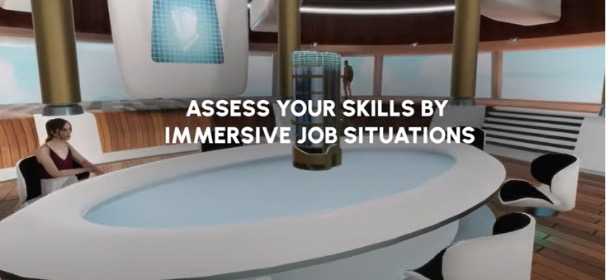
What if the metaverse also had a real part to play in spotting talent and making recruitment easier? Manpower believes it does, and has teamed up withEvaveoto create a metaverse dedicated to recruitment. Once they have chosen their avatar, candidates can have their skills assessed live in playful, immersive professional situations. At the end of the experience they are given feedback along with personalised career advice.
The limits and challenges of the metaverse in training
1
Rules to be set
New enclosed spaces and places where people live together mean new rules to establish. The first concerns liability: what responsibility do the publishers bear for the content? Who is answerable for what is said, particularly in closed discussion spaces? How do you deal with possible excesses — violence, harassment? What moderation should be put in place? These questions, which every organisation will have to ask itself, are more or less identical to those put to social network publishers.
The rules that will govern the training market tomorrow also have to be rewritten. The articlehttps://www.edsurge.com/news/2022-01-24-what-could-web3-mean-for-educationsets out the limits of a decentralised system, favoured by some EdTech players, that would upend existing business models. Among them: crypto entrepreneurs are imagining other systems for education, turning schools and teaching sites into transactional platforms. Are these better, or simply more profitable?
As the investor Balaji Srinivasan, former CTO of the cryptocurrency company Coinbase, said in an interviewhttps://tim.blog/2021/11/17/balaji-srinivasan-2-trancript/, everything could be for sale in the crypto future, even “things we could never price before, like a minute of your time”.
2
Risks to weigh
At a time when everyone is increasingly conscious of energy, it is important to take account of how energy-hungry the metaverse is. Bringing hundreds of people together in online 3D environments necessarily consumes resources and data, and calls for a review of infrastructure (https://www.globalsecuritymag.fr/Metavers-quelles-infrastructures,20220407,123979.html)
The ever-thorny question of the digital divide also comes up again. According to the report published on the Brookings site,https://www.brookings.edu/research/a-whole-new-world-education-meets-the-metaverse/“that is largely what happened with the introduction of ‘educational’ apps designed to be used on smartphones and tablets meant for adults. Today, while the infrastructure of the metaverse is still being built, researchers, educators, policymakers and digital designers have a chance to lead the way rather than inherit the technological environment.” Educators, students, companies and learners find themselves doing new sums and organising themselves: all of them have to set the rules for living together well, and to arbitrate between traditional organisations, whose teaching quality has already been measured, and decentralised providers dangling the tempting prospect of a bigger financial return.
The metaverse and training: should you take the plunge?
So: evolution or revolution?
Let’s be straightforward about it: the metaverse has the appeal of novelty and adds an undeniable element of enjoyment, not least through gamification — which already counts for a lot — but in our view, as things stand today, it offers no revolution in learning as such.
Should you therefore ignore this new tool? Absolutely not. On the contrary, it seems to us important to invest in it and to understand how it works, so you can make the most of it: stay trained and informed to follow how it may develop in the training field, and use it now for events (course launches and the like), where it fits perfectly and will deliver a genuine wow effect.