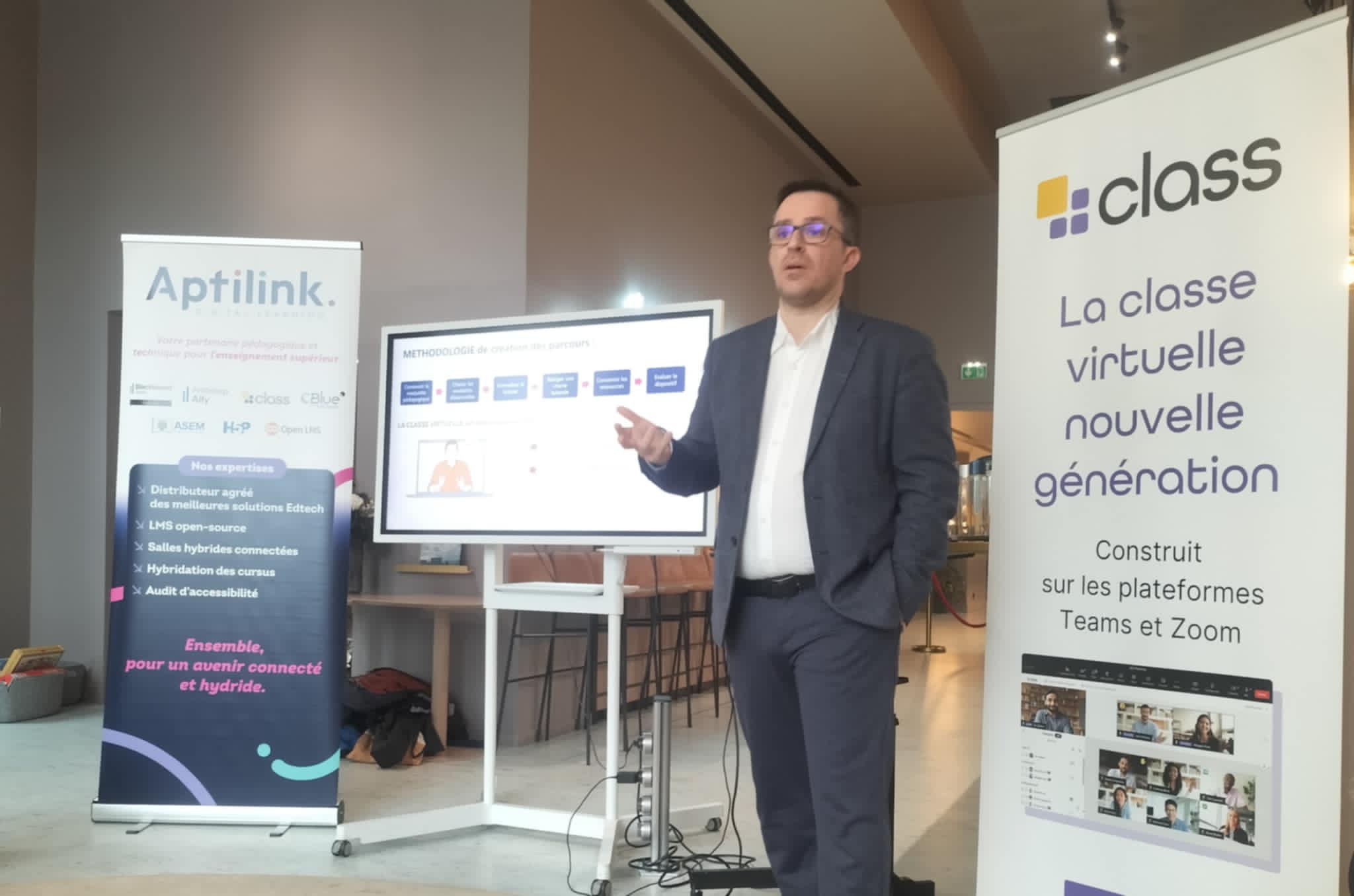
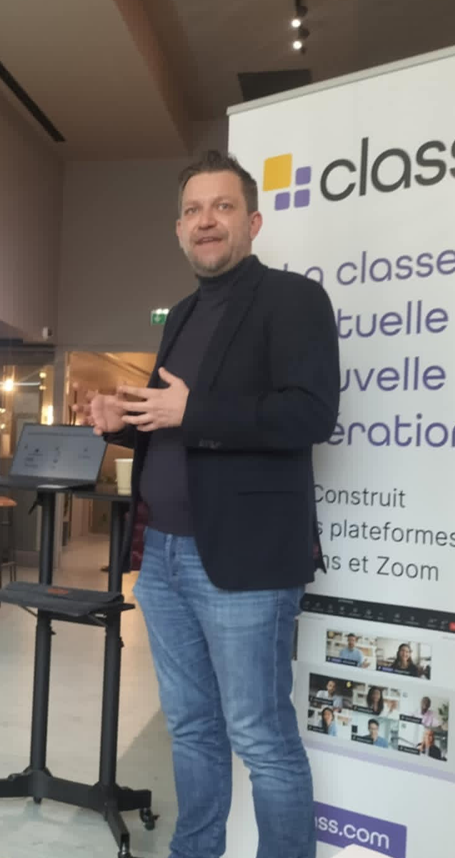
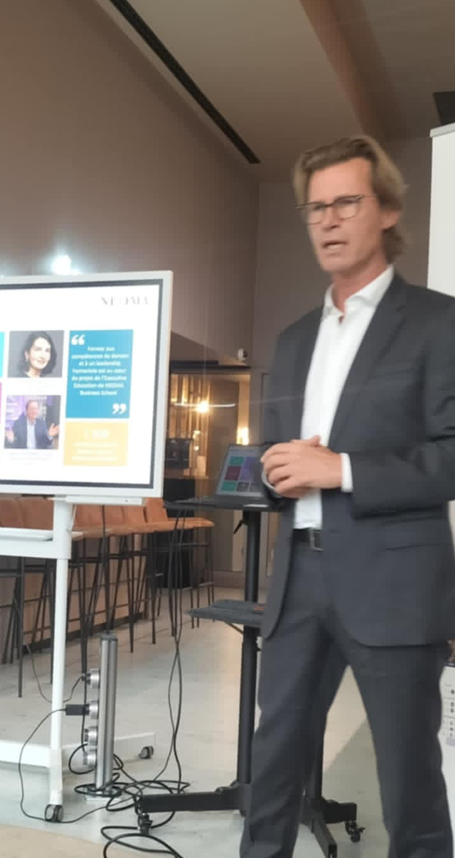
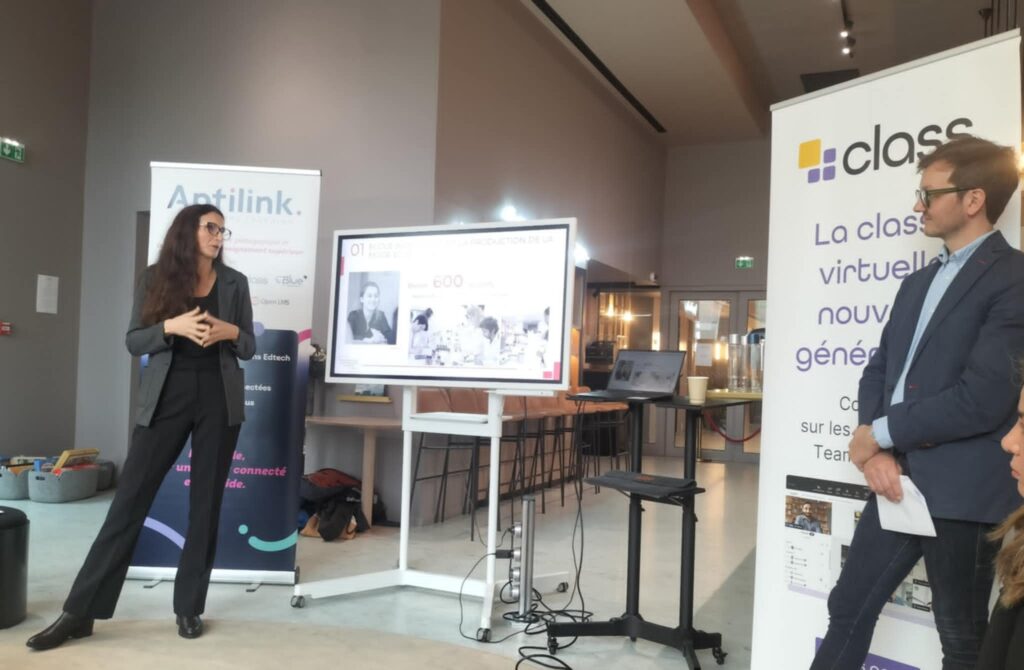
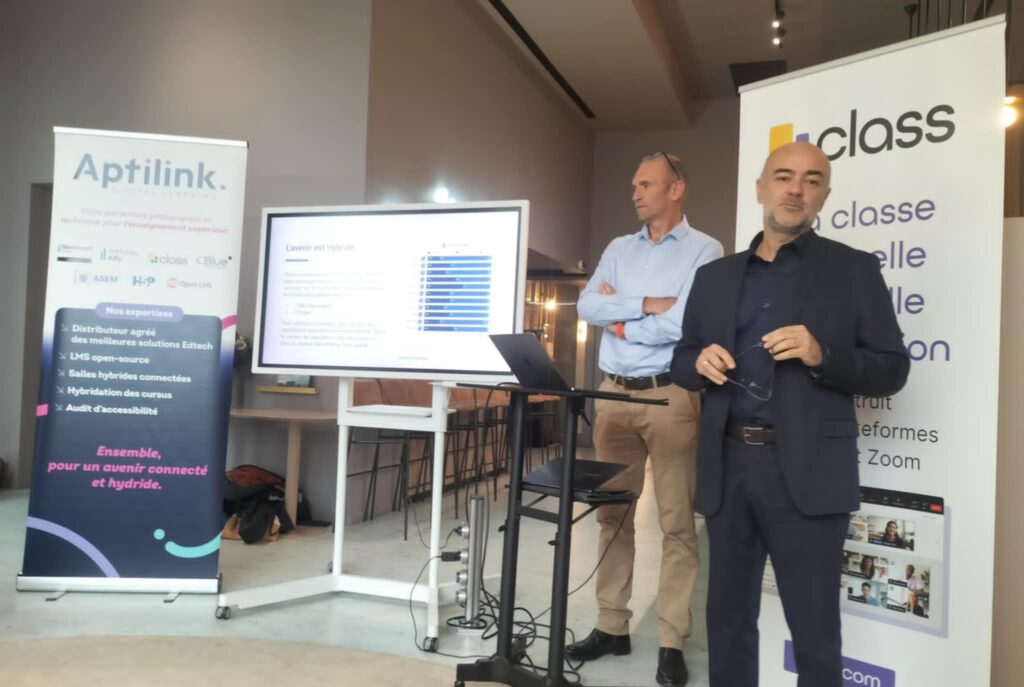
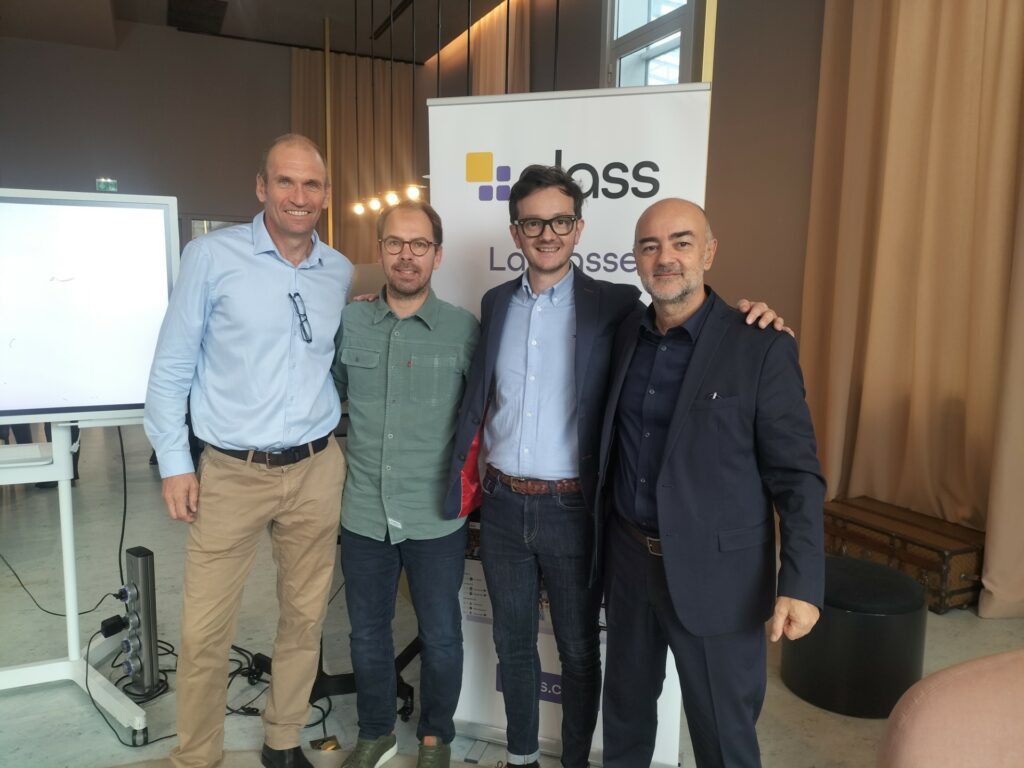
A look back at Classday , held on Thursday 7 November in Paris, which brought together experts and enthusiasts in digital learning over breakfast and a series of rich, instructive talks.
The event, organised by Aptilink, Rise Upand CLASS, leading names in digital learning in France, was a chance to discuss the trends, the challenges and the practical experience around the use of the virtual classroom through a number of talks and client accounts.
Thefuture of continuing education is taking shape aroundhybrid learning, combining classroom and remote delivery with collaborative technologies. Pioneering institutions in various sectors, such as FERRANDI, NEOMA Business SchoolandISIPCA, have already adopted this model to meet the specific needs of learners, who often face constraints of time and location , using the innovative next-generation tools offered by CLASS and Rise Up.
By combining synchronous training (virtual classrooms, real-time tutoring) with asynchronousformats (self-study modules, learning videos), these institutions offer flexible pathways, that are well matched and engaging, while keeping the human follow-up that is crucial to guaranteeingautonomyandengagement , so as toavoid boredom and theisolation of learners.
A closer look at what our partners and clients told us about what the virtual classroom brings to thehybridisation of their learning pathways.
Improving learning in continuing education through hybrid delivery
David Maily, Head of Development and Learning Innovation at FERRANDI PARIS
FERRANDI, one of France’s leading schools of gastronomy and the culinary arts, has adopted a hybrid model for its continuing education courses. The approach blends synchronous and asynchronous activities to meet the needs of an adult audience, often made up of working professionals with personal and professional constraints. The hybrid model lets learnersprogress at their own pace while benefiting from personalised support, through virtual classrooms and real-time tutoring. The feedback is unanimous: the pathways are more motivating and learners are more autonomous, supported by structured tutoring and high overall satisfaction.
Virtual classrooms and online meetings: two distinct formats. Why did Rise Up partner with Class?
Frédéric Hebert, Chief Product Officer at RISE UP
Rise Up, which publishes an LMS/LXP solution, champions blended learning by offering a multimodal, flexible learning experience. Its platform combines digital, classroom, synchronous and asynchronousformats, giving learners great adaptability while maintaining a strong link to the teaching community. Thanks to the integration of CLASS, the Rise Up solution lets trainers manage their sessions easily, with interactive features such as real-time meetings, breakout group management and individual tracking of learner progress. This interconnection guarantees a smooth, coherent experience, strengthening both learner engagement and collaboration.
Client account: the place of digital and the virtual classroom in continuing education
Stéphane Dubreuille, Director of Executive Education at Neoma Business School
NEOMA Business School offers a fully digital programme dedicated to helping elite athletes move into a second career, particularly in rugby and handball. Aimed at learners at master’s level, the pathway stands out for its interactive, experiential approach, combining live sessions, des videos available on replay and practical role-play. With the virtual classroom solution CLASS, the school offers personalised follow-up, including real-time corrections and bespoke support. Integrating CLASS brings every element of the pathway together on a single platform, improving the distance learning experience. The setup has allowed the school toextend its training offer into new sectors, such as banking.
Client account: getting the most from the virtual classroom — synchronous training, oral assessments, hyflex delivery
Angie Fava Lopez, Learning Engineer & Elearning Designer at ISIPCA
ISIPCA, the French higher education school specialising in perfumery, cosmetics and food flavour formulation, adopted virtual classroomsquickly, particularly during the Covid-19 crisis. Around 600 students, 20% of them international, now follow fully digital courses, notably in perfumery, with practical kits sent out for remote experiments. The shift has increased flexibility for learners and visiting lecturers alike. Teaching staff, however, had to adapt their teaching methods to meet the demands of remote delivery.
Integrating CLASS into the Blackboard LMS has transformed the learning experience by making courses more interactive and by making collaborative work easier. With features such as session scheduling and real-time progress tracking for students, CLASS answers the growing demand for education that is both flexible and engaging.
A next-generation virtual classroom compatible with MS Teams and Zoom
Emmanuel Clemot, Regional Manager for the Middle East and Africa, and Massimo Gentili, General Manager for Europe, the Middle East and Africa, at CLASS
The future of teaching rests increasingly on a hybrid model, where classroom and remote delivery complement each other through collaborative technology. CLASS positions itself as one of the best tools for managing that transition, offering unique features that other virtual classroom platforms, such as Teams, do not have. Compatible with Microsoft Teams and Zoom, CLASS lets you bring learning content together in one place and run courses in real time with advanced engagement tools : spotlighting speakers, managing interactions, tracking participation and collaborative work. It also includes detailed learner tracking, letting trainers see participation rates andhow involved students are.
Integrating CLASS into an LMS such asRise Up allows smooth management of the training, bringing all learning resources together, allowing sessions to be scheduled, and giving a complete view of students both quantitatively (participation, progress) and qualitatively (engagement, behaviour). This approach helps transform the online learning experience, making it more interactive, collaborative and personalised.
In closing: hybrid training and the virtual classroom, a promising outlook
Thehybridisation of training, supported by a range of technologies such as the CLASS and RISE UPsolutions, opens new possibilities for digital learning, particularly for adults changing career or learners with particular constraints. By offering pathways that are flexible, interactive and personalised, educational institutions, companies and training providers can meet the needs of a diverse audiencewhile improving learnerengagement, la collaboration and success . With thesmooth integration of virtual classroom tools into LMS platforms, the future of hybrid learning looks promising, offering an enriched experience matched to the demands of working life.
Get in touch!
A new project? A question about digital learning? Face-to-face training to take online. Our team of specialists is here to help.